Tornado & Storm Flood Water Damage Restoration In Arley, AL
Need Tornado & Storm Flood Water Damage Restoration Arley, AL? One free call connects you with a local pro who can arrive in 30–60 minutes — extraction, drying and cleanup, 24/7.
MVBHDJSLCS★★★★★“Severe flooding swamped our basement workshop in Florence” — Richard Henderson, Florence
Free To CallAnswered 24/7Independent Local ProsNo ObligationServing 31 Alabama CitiesOne Free Call
Free To CallAnswered 24/7Independent Local ProsNo ObligationServing 31 Alabama CitiesOne Free Call
Quick Answer
Storm water in your Arley home? One free call connects you with a local pro who can arrive in 30–60 minutes. 54.1% of Arley homes were built before 1980, so hidden moisture is a real risk here. The median Arley home was built in 1978 — older framing holds water longer and dries slower.
Is My ZIP Covered?
Type your Arley ZIP code to check it against the ZIPs we serve here.
One free call connects you with a local pro in Arley for the storm and flood work below.
Water Extraction Services
In Arley, water extraction starts with the rooms that hold the most water and works outward. Pros use submersible pumps and extraction wands, then meter the walls and floors so the drying plan for your Winston County home is based on readings, not guesses.
After the water drops, Arley homes are left with mud, silt and ruined belongings. Flood cleanup clears the debris, washes down surfaces and gets the structure ready to dry — the unglamorous work that decides whether a home recovers cleanly.
Extraction removes the water you can see; structural drying removes the water you cannot. In Arley's older homes — median build year 1978 — moisture hides in cavities, so pros dry with measured airflow and check progress with meters, not timelines.
Roof tarping is the fastest way to stop storm damage getting worse in Arley. Pros cover torn decking and missing shingles with a secured tarp, then the water already inside can be extracted and dried.
When storm flooding overwhelms drains in Arley, sewage can enter through the lowest fixtures. Pros handle it as contaminated water from the first minute — extraction, removal of unsalvageable materials, disinfection and drying, in that order.
Mold can start growing within a day or two of a Arley flood. Remediation removes colonies on walls, baseboards and in crawl spaces, contains the work area so spores do not spread, and fixes the moisture that fed them.
Arley is a small town without separate named neighborhood districts, so we list coverage by the ZIP areas we serve. Wherever you are in Arley, the same free call connects you with a local pro.
Arley — ZIP 35541
Homes across the 35541 part of Arley — including streets near the town center and the roads out toward the county line — are covered by the same free call.
Storm Water In Your Arley Home Right Now?
Water spreads fast after a storm. One free call connects you with a local pro who can start today.
Real reviews from Alabama homeowners after storms and floods.
DF
Dustin Foley
★★★★★
Storm water flooded our church fellowship hall in Phenix City. The restoration team worked around the clock to pump water, treat surfaces, and dry out the carpets.
RD
Rebecca Dalton
★★★★★
Extremely grateful for their 24/7 emergency service. When flash floods hit Alabaster at 2 AM, they were on-site extracting water within 45 minutes.
AC
Arthur Chapman
★★★★★
Their moisture metering equipment and containment procedures are top-tier. Cleaned up substantial storm runoff in our Northport home with zero lingering odors.
MS
Melanie Sutton
★★★★★
Severe squall line blew debris through our windows in Athens, followed by heavy interior flooding. They secured the openings and dried the structure thoroughly.
CU
Craig Underwood
★★★★★
Good execution on emergency water mitigation in Fairhope. Technicians were respectful and cleaned up debris before packing up equipment.
GB
Gloria Barnett
★★★★★
They treated our family with such kindness after a tornado destroyed our sunroom in Troy. Water damage was confined and dried completely within days.
RN
Russell Newton
★★★★★
Great communication, modern drying systems, and zero hassle with billing. They mitigated flood damage in our Selma property cleanly and quickly.
VD
Valerie Dawson
★★★★★
Storm runoff entered our finished basement in Helena. The technicians took baseboards off cleanly, drilled discreet drying holes, and saved our walls from total replacement.
TF
Timothy Floyd
★★★★★
Top-notch water extraction following high winds and roof leaks in Jasper. Everything was moisture-tested daily until dry standards were met.
JM
Joyce Moran
★★★★★
Very capable restoration crew in Calera. Drying equipment took up significant space, but it removed all traces of water quickly.
PV
Phillip Vance
★★★★★
A severe storm surge flooded our ground-level rental units in Gulf Shores. Their crew sanitized and dried all three units promptly, preventing mold infestation.
SC
Stephanie Collier
★★★★★
They made an unbearable situation manageable after a tornado hit our street in Jacksonville. Rapid board-up, professional water extraction, and genuine care.
Tornado & Storm Flood Water Damage Restoration Near Arley
Usually inside the hour. Arley's ZIPs — 35541 — are all inside the local crews' standard run, and the line is answered 24/7.
The work covers water extraction, structural drying, removal of unsalvageable materials, cleaning and a mold check. What your Arley home needs exactly depends on how much water entered and how long it sat — the pro measures first, then quotes.
Three causes lead in Winston County: wind tearing shingles and siding so rain pours in, flash flooding pushing water through doors and crawl spaces, and roof leaks that drip quietly for days. FEMA rates the county relatively low for riverine flooding (64.7 of 100).
Age shows up in the drying plan. In Arley's older housing stock, moisture sits in cavities and under old floors; pros find it with meters and thermal imaging instead of assuming the surface tells the story.
All of them — 35541. If you are near the town line, call anyway: coverage follows Winston County, not just the city limits.
Keep out of standing water near outlets, turn off power to wet rooms only from a dry spot, move rugs and boxes to dry ground if it is safe, and take photos of every damaged room. Then call — extraction in the first hours saves the most.
Often, but not always. Insurers separate wind-driven rain from rising water, and they pay on documentation. That is why Arley pros photograph and meter everything before extraction starts.
Expect several days of equipment time. Drying ends when moisture readings reach dry standards — in most Arley homes that is day three to five; older or heavily soaked structures take longer.
In Alabama humidity, assume the clock is 24–48 hours. If a musty smell appears in your Arley home after a storm, growth has likely started and should be checked, not sprayed and hoped away.
Anyone who quotes sight-unseen is guessing. The real drivers are water volume, rooms and materials affected, time before extraction, and contamination. A Arley pro inspects, then quotes — you approve before anything begins.
Local Factors: Why Storm Flood Damage Hits Arley Homes
Winston County storm profile shapes every job in Arley. FEMA's index puts riverine flooding at relatively low (64.7 of 100) and tornadoes at relatively moderate (79.2 of 100) for this county — plus relatively moderate strong wind and relatively low hurricane risk.
The housing stock adds to it. Arley has about 523 residents and 209 homes; 54.1% were built before 1980 and 75.8% are owner-occupied. At roughly 722 feet elevation, water behaviour differs street by street — low lots and crawl-space homes flood first, and older framing dries slowest.
Arley At A Glance
54.1%
Homes From Before 1980
U.S. Census Bureau, ACS 2024
Relatively Moderate
FEMA Tornado Risk (County)
FEMA National Risk Index, Dec 2025
Relatively Low
FEMA River Flood Risk (County)
FEMA National Risk Index, Dec 2025
523
People In Arley
U.S. Census Bureau, ACS 2024
722 ft
Elevation
USGS National Map, 2024
75.8%
Homes Owner-Occupied
U.S. Census Bureau, ACS 2024
What Is Tornado & Storm Flood Water Damage Restoration In Arley?
It is the work of putting a Arley home back after storm water gets inside: extracting standing water, drying the structure, removing what cannot be saved and checking for mold. Arley is a storm-exposed Winston County town — FEMA rates the county relatively moderate for tornadoes and relatively low for riverine flooding. In a town of about 523 people, word travels fast after a storm — and so does water, from the first room into the walls behind it. Homeowners comparing options can also read how the work is handled in Addison and Bear Creek.
What Are The Signs Of Storm Water Damage In A Arley Home?
The clearest signs are standing water, a growing ceiling stain, spongy or buckled floors, and a musty smell that was not there before the storm. At 722 feet elevation, Arley homes still hide water in cavities and under floors long after surfaces look dry. Our guide to signs of water damage in walls shows what to look for.
Here is what the data says about Arley. 79.2 score / 100 — Rank 21 Of The 31 Alabama Cities We Serve · 64.7 score / 100 — Rank 23 Of The 31 Alabama Cities We Serve. Crews plan around those figures — they are also listed in the comparison section below.
How Do Tornadoes And Storms Flood Arley Homes?
Three ways, mostly. Tornadoes and straight-line winds tear shingles and siding loose, and rain pours into attics and walls. Flash flooding pushes water through doors, garages and crawl spaces on lower ground. And a damaged roof can leak quietly for days before a stain ever shows. Arley's elevation is about 722 feet, but low streets and creek-side lots still take water first.
What Happens To Wet Drywall And Insulation?
Drywall wicks water upward past the visible waterline, and wet insulation holds moisture against the framing. Crews in Arley meter the climb and remove only what cannot dry, which keeps good material in place and the bill honest.
What Does The Restoration Process Look Like In Arley?
First the water comes out. Then the structure is dried to a plan: readings first, equipment placed by room, progress checked every day. What cannot be saved comes out and is documented: saturated padding, swollen laminate, drywall that has lost its strength. The county-wide picture is on our Winston County page.
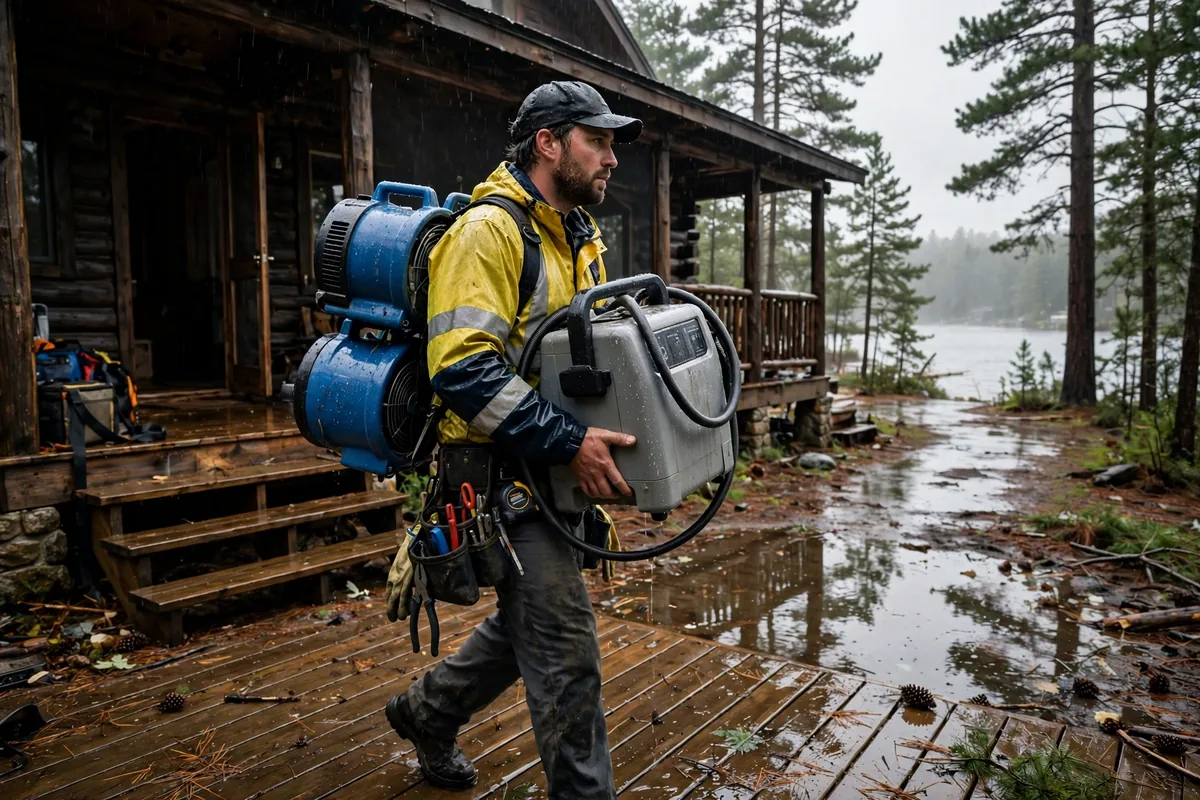
Expect real equipment, not a mop: water extraction first, then structural drying — an air mover and a dehumidifier per wet room — guided by moisture meter readings and thermal imaging. Crews also open wet drywall and insulation where needed, check the subfloor, inspect the crawl-space vapor barrier, and tarp a damaged roof the same visit.
What Affects The Cost In Arley?
Four factors: how much water entered, how many rooms and materials it touched, how long it sat before extraction, and whether mold has started. The assessment is what turns a guess into a quote — and the assessment and the call cost you nothing.